ILGA Europe’s 2026 Rainbow Map – The Good, The Bad & The Ugly

The past few years have been difficult for LGBTQIA+ communities. We’ve seen a rapidly worsening environment for all LGBTQIA+ people, but particularly trans people, across the UK and to an extent in the Republic of Ireland as well. It’s rare, however, that we can see it so starkly presented, with facts, data, and comparison across Europe.

The ILGA Europe ‘Rainbow Map’, released every year, provides us with the opportunity to do just that. It ranks each country in Europe based on their approach to LGBTQIA+ rights across a range of areas:

  • Equality and non-discrimination;
  • Family;
  • Hate crime & hate speech;
  • Legal gender recognition;
  • Intersex bodily integrity;
  • Civil society space;
  • Asylum.

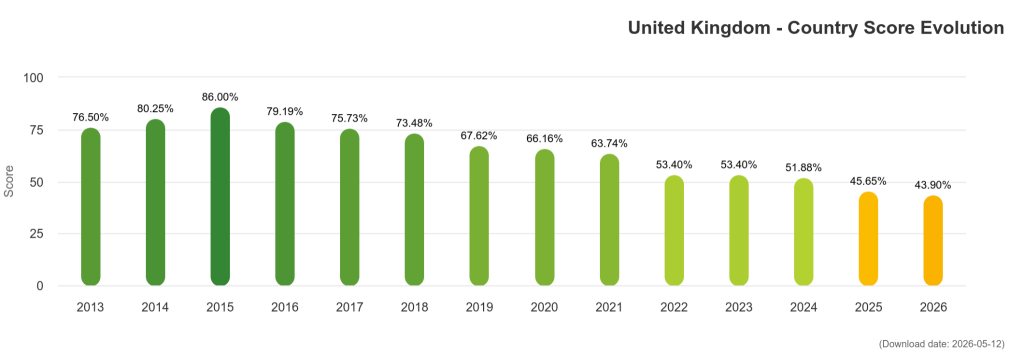
Historically, the UK has sat quite high on the list of European countries, topping the rankings for the first three years since the first Rainbow Map in 2013. The world has changed a lot in the following 13 years, and both the UK and the rest of Europe are in a very different position regarding LGBTQIA+ rights.

So let’s break down the UK’s ranking and position in comparison to the rest of Europe: the Good, the Bad and the Ugly.

The Good

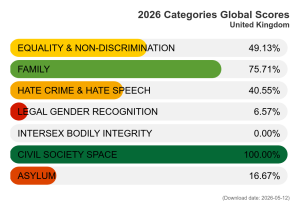
 With only one exception, the UK otherwise maintains all the points across these categories which it held in 2025. The key strength of the UK is in its support for a healthy civil society space – enabling LGBTQIA+ people and communities to freely assemble for Prides, and LGBTQIA+ organisations such as ourselves to operate freely.
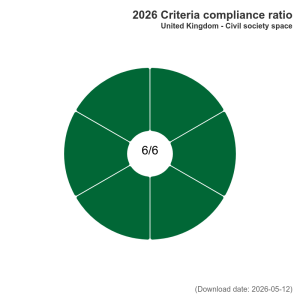
Across LGBTQIA+ sectors in the UK, there is a sense that this is changing, with hostile litigation from anti-LGBTQIA+ groups and an increasingly hostile political space making it more difficult for us to operate – however, in comparison to some areas of Europe where Pride marches have been banned and LGBTQIA+ civil society is suppressed, the UK still maintains a more open environment for LGBTQIA+ organising.

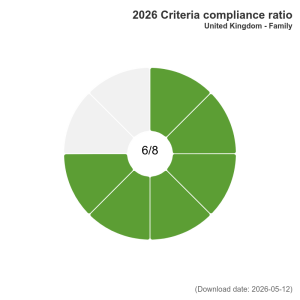
The UK has also held onto points in the areas of ‘Equality and Non-Discrimination,’ ‘Hate Crime & Speech’, and ‘Family’. The record in these areas is more patchy.

While individuals across the UK are protected from discrimination on the basis of their sexual orientation and gender identity, these protections look slightly different for trans people in Northern Ireland, and don’t extend at all to intersex people in Britain or Northern Ireland.
 

Britain has hate crime laws covering homophobic and transphobic hate crime, whereas in Northern Ireland, only homophobic hate crime is covered, and the model for prosecuting this crime is outdated and ineffective. Only Scotland has protections for intersex people within its hate crime laws, and included within this legislation comprehensive hate speech provisions.
The Bad

 The ‘Family’ category has previously been one of the UK’s strongest areas, with the Human Fertilisation and Embryology Act providing protections for same-sex couples who have children through artificial insemination. However, a recent High Court judgment has challenged this positive record, with a transgender man who gave birth to his child losing a challenge against the Government’s refusal to have him recorded on the child’s birth certificate as their father. The Government has also failed to bring into law any specific protections for trans parents, which is having significant impacts on the ground in Northern Ireland and across the UK for trans people who wish to start a family.

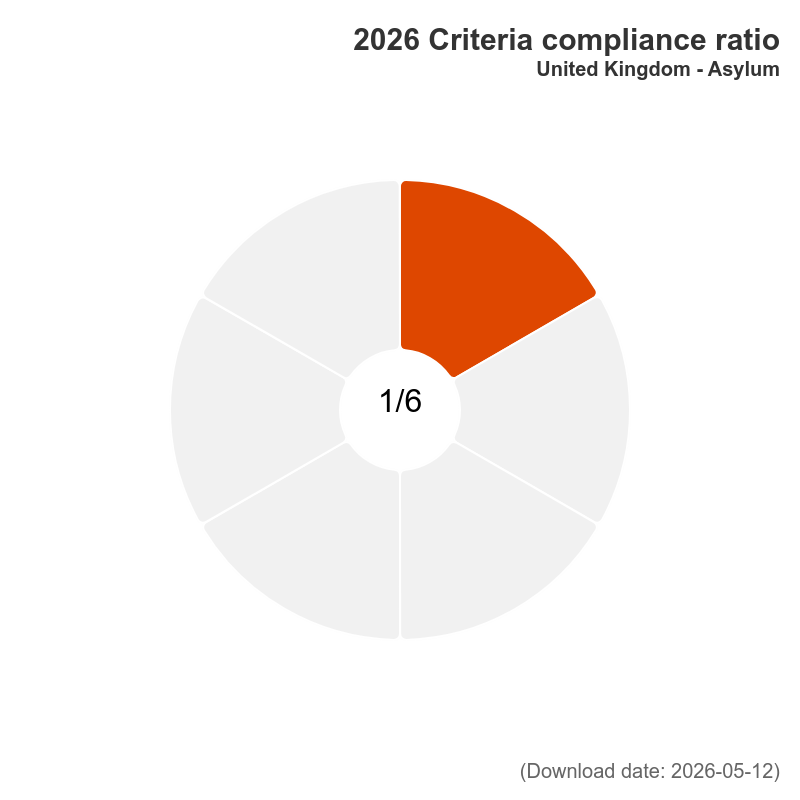
Across other areas including ‘Asylum’, ‘Legal Gender Recognition,’ and ‘Intersex Bodily Integrity,’ the UK scores abysmally. Following years of regressive policies and approaches to asylum reform, the UK only retains one point in the ‘Asylum’ category. For anyone working with LGBTQIA+ asylum seekers in recent years, this will ring true – the approach of the Home Office to LGBTQIA+ asylum seekers has become increasingly hostile, and legislative interventions such as the Illegal Migration Act have restricted asylum seekers’ rights even further.

A change of course, respecting the right to claim asylum and the importance of specific support for LGBTQIA+ asylum seekers, is vital for ensuring those individuals who are fleeing persecution and often violence are not retraumatised through our asylum processes. 

On legal gender recognition, the UK lost significant ground last year, following the passage of the ‘For Women Scotland’ Supreme Court Judgment redefining the terms ‘woman’ and ‘sex’ in the Equality Act. 
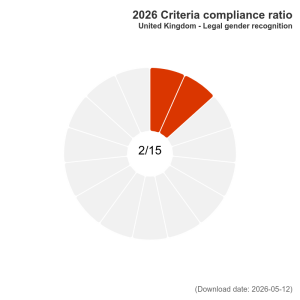
While this judgment was regarding the Equality Act, it also has impacts on the Gender Recognition Act (GRA). The 2004 GRA was intended to allow someone to change their legal sex for all purposes, including for the purposes of non-discrimination legislation.

This judgment undermined that position and, while we are yet to see the full impacts, resulted in a dramatic drop in points for ‘Legal Gender Recognition’ last year. The UK has also made no progress whatsoever in protecting the bodily integrity of intersex people, and continues to allow for unnecessary medical and surgical interventions on interventions on intersex infants.
The Ugly

This is part of a wider trend: in 2015, the UK sat proudly at the top of the list in Europe, acting as a beacon of hope and progress for LGBTQIA+ communities across Europe who saw that positive change could be made. Following 11 consecutive years of decline and stagnation in LGBTQIA+ rights, the UK now languishes at 22nd on the list.

Attacks on the rights of trans people and asylum seekers, particularly in the context of the Supreme Court judgment and recent regressive asylum legislation, is having a wider impact on the enjoyment of rights for all LGBTQIA+ people. It serves as a reminder that human rights are, or should be,  universal, and that the removal of rights for one often signals a degradation in the rights of all. Progress cannot be taken for granted, and we all must work together to progress the rights of all LGBTQIA+ people, and everyone else as well. 

So... What now?

It’s clear that both the UK Government, and devolved Governments in Scotland, Wales, and Northern Ireland, must step up to the plate and deliver real change for LGBTQIA+ people. In Northern Ireland, we have a number of clear opportunities to make positive change.

The recent success on funding for gender affirming care services will take time to bed in, but could massively improve the lives of trans people across Northern Ireland – that is, if it is delivered in a way that respects the rights, autonomy and identities of the patients seeking to access it. We will continue to push the Department of Health to meaningfully involve trans communities in the design and delivery of this service.

We also have the opportunity to increase protections for LGBTQIA+ people against hate crime, and against conversion practices. The Justice Minister’s Sentencing Bill seeks to reform how hate crime is dealt with by the criminal justice system, implementing a more effective system for both prosecuting hate crime and rehabilitating offenders. We are working hard to ensure that transphobic hate crime is also covered within this new legislation, for the first time ever in Northern Ireland.

We are working with Eóin Tennyson, Alliance Party MLA for Upper Bann, to support his development of a ban on conversion practices in Northern Ireland, while also lobbying the UK Government to ensure that its ban covers all four nations. Whether via Stormont or Westminster, we are determined to secure a comprehensive, trans-inclusive ban on these abhorrent practices.

But this isn’t enough – we need to see real progress across a wide range of areas, and a reversal of the backslide on trans rights. From making gender recognition more accessible; improving access to fertility treatment and preservation for same-sex couples in Northern Ireland; banning unnecessary surgeries on intersex infants; meeting the target of reducing HIV transmissions to zero by 2030; respecting the rights of LGBTQIA+ asylum seekers to safety and dignity; and improving LGBTQIA+ inclusion in education and the workplace.

This is just a number of ways in which the UK can, and should, reverse the decline, once again becoming a global leader on LGBTQIA+ rights.

Share this page