
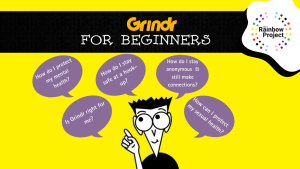
Grindr for Beginners
Grindr is a social media app that’s largely used by men who are gay, bisexual, queer or have sex with men, and trans or non-binary people for finding someone to have sex or sext with, to date or even just to befriend.
Grindr says it’s the world’s largest social-networking app for queer and trans people – and it often feels like everyone uses or has used Grindr!
However, it’s not everyone’s ‘thing’ and if you don’t like it or don’t want to use it, that’s totally okay too! You can absolutely find friendship, love and sex off the app IRL (or ‘In Real Life’)
But we often have people who are new to hook-up apps, to exploring their sexuality, or are more tech-weary than tech-savvy ask – just exactly how can I get started on Grindr?
So, we’ve created a comprehensive guide on everything you’d need to know to use Grindr confidently, comfortably and more safely including;
Before you join Grindr…
Have realistic expectations: You may not meet ‘Mr. Right’ or even ‘Mr. Right Now’ immediately. You’ll possibly be left on read more often than hit it off with someone. Prepare yourself mentally to feel disappointed.
Consider it practice: Take a view that relationships, sexual encounters or even just chats are experiences that help you learn what you want and how to ask for it. Then even awkward or disappointing experiences can feel beneficial.
What do you want: Have a think about what you’re looking for. Is it a hook-up, a relationship, a date, steamy chats or friendly banter? Knowing what you’re looking for (or not) is the first step to learning to how to communicate your boundaries. And knowing what you want means you’re more likely to be able to find and connect with people who have similar goals on the app.
What’s good about Grindr?
Easy to connect: Never been easier to find gay or bisexual men, MSM and trans people or non-binary people for chats, dates & hook-ups.
Find compatibility fast: Know if you’re sexually compatible (positions, kinks, condom use etc.) before hooking
up or even if they’re just looking for ‘mates & dates’ like you might be.
Protecting your sexual health: Being able to ask about someone’s STI status or seeing it displayed on their profile, and negotiatingsafer sex practices before meeting-up.
Discreet: Grindr can be used discreetly, and it’s possible to remain anonymous whilst browsing or engaging with others – even if you’re sending explicit photos or videos.
What’s hard about Grindr?
Direct or blunt: Looking to build a connection before exchanging sexts, explicit photos and videos, or hooking up? That may not happen! Grindr users can be direct sometimes even blunt about wanting sex ‘right now’
Catfishing: People may use old out-of-date pictures or not even be the same person whose photos they’re using.
Risk of sextortion/blackmail: Be careful who and how you send explicit pics or videos to. Some might try to blackmail you with them.
Rejection: Just like any dating app, you’ll make more swings & misses than you do hits!
How to make your profile stand out for more responses i.e ‘Staying Fresh’
Have your profile be visible to more people. Your profile will be ‘fresh’ if:
- Your Grindr profile was created within the last 72 hours
- You’ve uploaded one or more new photos in the past 24 hours
So, if you’re not getting any messages, or ‘taps’ (i.e an emoji reaction to your Grindr profile) maybe upload a new photograph to your profile.
Even if you’re using Grindr anonymously (i.e without a profile picture of your face) you could still get that ‘fresh’ status by uploading a new photograph such as a picture of your body, a scenic view, or any other image.
How to make your profile stand out for more
responses – even if you’re using Grindr anonymously.
On Grindr most people say ‘NPNC’ (no picture, no chat) meaning that they don’t want to interact with profiles who do not have a profile picture. So, if you’re trying to stay anonymous and not want to upload a face picture – you will likely be more successful either:
- Interacting with other users who don’t have photographs of themselves in their profile pictures.
- Having a profile picture of your body (remember to hide any identifying features such as tattoos or piercings)
- Mentioning in your profile bio that you’re more comfortable sharing face pictures once you’ve began chatting with someone (if applicable to you)
What are ‘tribes’ and ‘tags’?
Tribes lets you select up to three the sub-communities you’re interested in engaging with. It’s not about how you
identify but to reflects who you’re into.
Tags offer you more options to describe who you are. You’re able to add up to ten ‘tags’ to your Grindr profile. Adding ‘tags’ to your profile makes it searchable by other users, allowing folks to connect on Grindr more easily. It’s much easier to break the ice when you can rely on common ground.
You can add ‘tags’ that describe your personality, kinks, or hobbies. For a detailed list of available ‘tags’, ‘tribes’ and what they mean visit click here
How to stay anonymous or protect your identity when sending explicit photos or videos?
Even if it’s not necessary for you to use Grindr anonymously – it’s important to ensure any explicit photographs and videos do not specifically identify you. We would recommend that when try to avoid videoing or photographing any identifiable features (face, tattoos etc.) You could cover certain features using stickers or emoji in your phone’s photo editing programme.
How to use in-app features like ‘expiring photos’?
All ‘expiring photos’ can only be viewed once, and
it’s not possible to capture a screenshot of an expiring photo. If you don’t
pay for Grindr XTRA or Unlimited you can send only one expiring photo per day.
To send an expiring photo:
- Select the photo or photos you want to send by tapping on it.
- Tap on the countdown button represented by a chronometer or watch.
- Tap Send Expiring.
It is worth noting that since January 2026, users on either Android or iOS will not be able to take screenshots of images sent via chat – but that there are other techniques people may use to download images sent in chat so use caution when sending photographs or videos.
For more information about sending and receiving expiring photos click here
How to use in-app features like STI testing reminders?
Grindr can send you an in-app message reminder to get an STI test. Testing reminders are only sent to you and will not be visible to other members.
- Click ‘edit profile’
- Scroll down to ‘Health’
- Click ‘Remind Me To Get Tested After’
- Select whether you’d want a reminder in 3 or 6 months.
You should get be getting tested at least once per year, once every three months if you’re more sexually active or anytime you’ve had unprotected sex. For more details on how to get tested in Northern Ireland click here
What to discuss with your partner before meeting for a hook-up?
- Ask them for their STI status or when they last had an STI test.
- Sharing your own STI status or when you last got an STI test can mean their more comfortable to discuss their own.
- i.e., “I just had a rapid HIV & syphilis test last month, what about you?”
- Discuss condom usage and/or PrEP
- Remember that PrEP only protects you from HIV not any other STI like a condom would.
- Discuss boundaries
- What kind of sex are they looking for? Is it what you’re into too?
- Remember even if you or your partner have talked about a sex act beforehand – consent must be given just before you start and anytime you change positions!
- Where to meet?
- If possible try to meet someone in public, even briefly, for the first time before you hook-up.
How to stay safer at a hook-up?
- Meet in public first
- Can you meet for a coffee or a drink first? Or even just meet at the bus or train station beforehand?
- This gives you an opportunity to feel out whether your hook-up is who they say they are, if you feel safe or comfortable with them and if you’re interested in them.
- Don’t want to host or visit a first-time hook-up?
- Consider using an on-site sex premises like a sauna where they’d be lockers to keep your belongings, sanitary rooms for sexual encounters and communal areas for socialising.
- Check-in with a friend
- If you can, tell a friend when & where you’re going for a hook-up, and to raise the alarm if you don’t check in at an arranged time.
- Some use “traffic lights” to quickly and easily communicate with their friend when they might need help
‘Traffic Lights’ for checking-in with a friend
‘Traffic Lights’ are when you associate a colour (i.e red, yellow, green) with actions your friend can take to help support you when you’re at a hook-up. Then if you need to quickly and easily communicate with your friend you can do so by either texting the colour or sending an emoji of that colour. You can decide together what each action they must take for each colour but for example:
Red: Call PSNI or come pick me up
Yellow: Call with me with an excuse to urgently leave hook-up
Green: All is good!
How to protect your sexual health?
Get tested for STIs at least once per year or every three months if you’re more sexually active with multiple partners. For more information on STI testing visit click here
Consider taking the medication known as PrEP regularly to maximise your protection against HIV. You can learn more about PrEP click here
Use condoms and lube to protect against STIs – you can get these for free from any of The Rainbow Project centres or order online for home delivery click here
If you’ve had unprotected anal sex and are concerned you may be at risk of contracting HIV. Visit A&E or GUM to take PEP within 72 hours to dramatically reduce your risk. You can find more about PEP click here
Warning signs of sextortion/blackmail?
Sextortion is a form of blackmail where someone threatens to share intimate images of you online or offline unless you give in to their demands such as money, more intimate images or sexual favours. Look out for these warning signs that someone may be aiming to sextort you:
- Something does not add up — their online profile is not consistent with what you see and hear when you talk or chat with them.
- It happens too fast — they express strong emotions for you almost straight away, and pressure you to get nude or sexual in a video call.
- They make excuses — they say they can’t facetime or send a video and instead send a nude photo which they claim is of them.
- Asking for explicit pics/video that has identifying features like your face or tattoos in them
- If they’re too good to be true, they likely are!
What to do if you’re a victim of sextortion/blackmail?
- Do not panic.
- Remember, it is not your fault, and you have not done anything wrong.
- Contact PSNI (101) or Victim Support NI (028 9024 3133) Your case will be taken seriously and dealt with in confidence. You will not be judged.
- Do not talk any further to the offenders.
- Do not pay. The offenders often post the videos or images anyway
- Take screen shots or write-down any of the sextortion threats. Keep it as evidence.
- Report the user on Grindr
- Block the offender on ALL platforms and change your password on all accounts.
For more information on getting support as a victim of sextortion visit click here
Protecting your mental health
Whilst dating or hook-up apps can work for some. For others it sometimes negatively affects their mental health & wellbeing. When you’re not getting ‘taps’ or ‘swipes’ or matches it’s easy for that to affect your self-esteem and self-worth. You can start to compare yourself to other profiles whether that’s about your looks, career, achievements or lives and start to feel you’re “not enough” Especially with the opportunity of all these potential romantic or sexual matches online, the lack of meaningful connection can make you feel more alone. So, what can you do when dating or hook-up apps stop being fun?
Limit your time on dating or hook-up apps
- Consider when and how often youwant to check your dating or hook-up app.
- Set up an app limit via Digital Wellbeing (Android) or Screen Time (iOS) to temporarily disable an app when a
time limit is reached for the day or hour. - Instead of using dating or hook-up apps constantly in search of Mr. Right or Mr. Right Now, set an intention to use more meaningfully (i.e consistently responding to messages, trying to set up dates etc.) for a shorter period (i.e a month or three months)
Consider alternatives to the apps
- Socialise in-person (e.g runningclubs, classes, hobby related activities)
- Ask friends or colleagues if they have anyone they might introduce you to
- Visit LGBTQIA+ bars, cafés and events alone so that you can become more easily approached by others and become more comfortable putting yourself out there.
This doesn’t always mean you’ll end up with a date or a hook-up (but frankly neither do the apps!) but approaching people in-person can feel more rewarding and enlightening than on the apps.
If your mental health is being severely affected by app usage:
- Take a “digital detox” by temporarily deleting or blocking apps for a few days or weeks to see if your mental health improves.
- Establish boundaries with when and where you use your phone such as:
- A ‘no phone’ zone in your bedroom or dining room.
- Turning off push notifications to stop the compulsion to check your phone.
- Limiting screen time using built-in phone settings.
- Reflecting before opening an app – ask why you are doing it. If you are bored, find another activity. If you are lonely, contact a friend etc.
- Prioritise seeing your friends, family and community in-person. Even if you don’t feel like yourself or up to socialising, genuine connection will almost always be good for your mental health.
- Invest time into activities that don’t require screen time like exercising, painting, reading etc.
Seek professional help, if apps are causing severe anxiety, depression or impacting upon your life daily. You can contact us for support or make a self referral to our counselling service click here